

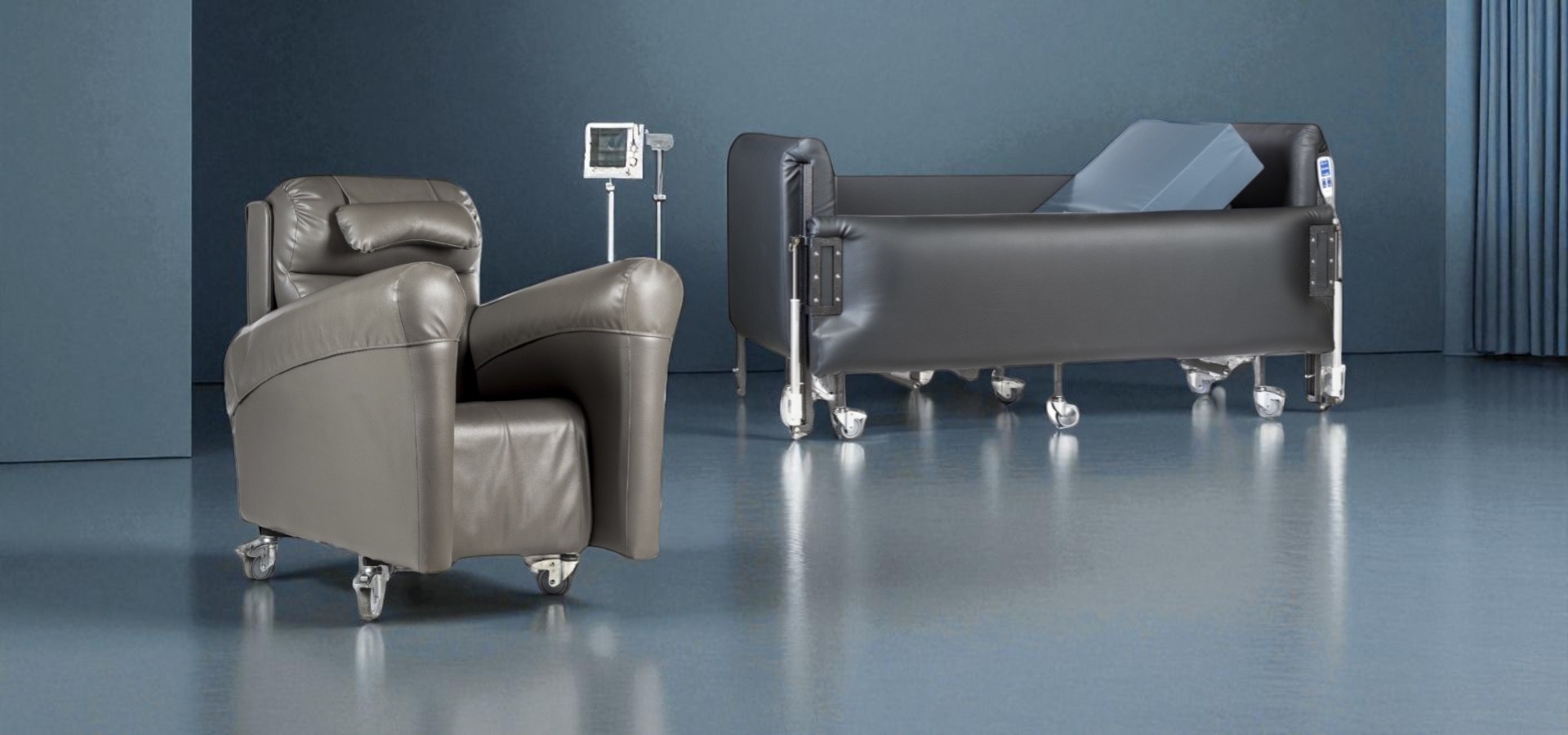
A bed and a chair serve different parts of the day. When a person lives with Huntington’s disease or another condition involving involuntary movement, a supportive chair does not answer every question about sleep, and a specialist bed does not settle daytime seating needs. Each item needs its own assessment, followed by a check of how the two fit the person’s daily routine.
Novacorr’s Novaprotect range includes a specialist Huntington’s Bed and Huntington’s Chair. A diagnosis does not establish that either product is suitable. The person, treating clinicians, occupational therapist and supporters need to consider the actual movement pattern, comfort, transfers, environment and goals.
Begin with the daily routine
Map where the person sleeps, rests, sits for meals, spends time with others and receives support. Ask what is difficult in each setting. Does movement change with fatigue or at night? Can the person move into and out of a chair or bed independently, or do supporters assist? What positioning is comfortable and meaningful to the person? Document what happens now and what the team reasonably expects may change.
This matters because a trial at one time of day can miss the needs that appear in another. Record the circumstances and the setup used during any observation, rather than treating one short trial as proof of all-day suitability.
Questions for the bed assessment
For sleep and overnight care, assess the mattress and surface, the person’s position and movement, access to controls, bed height, transfers, and the space supporters need at each side. Discuss the exact surround configuration and rail height with the treating team. Check mattress fit and any equipment used beside or under the bed, including a hoist. Consider how the person can call for help and how staff or family will reach them.
Protective surrounds and accessories must be considered with entrapment, exit, emergency access and any restrictive-practice requirements in mind. The Huntington’s Bed product page lists size and configuration options, but the quoted build and its compatibility should be confirmed for the individual. An option shown on a product page is not a clinical recommendation.
Questions for the chair assessment
Daytime seating brings a different set of tasks: getting into and out of the chair, maintaining a useful position, eating, communicating, relaxing, and joining others. Assess seat width and depth, back and head support, arm access, foot positioning, recline, controls and the support a carer needs to provide. Check whether the chair can be positioned where the person wants to spend time and whether it fits through the home’s access route.
The Huntington’s Chair has specialist padding and sizing options. The treating team should observe the specific configuration proposed, including the person’s response to its support and how transfers will work. A chair that looks protective in a photograph still needs an individual fit and use assessment.
Check the transition between bed and chair
If both products are being considered, study the changeover. Are the heights and transfer routes workable together? Where will a wheelchair or hoist go? Who helps, at what times, and what happens if function changes? A room layout with dimensions can reveal an access issue before purchase.
Compare the proposed bed and chair specifications on one page: measurements, support surfaces, controls, accessories, transfer method, cleaning, service access and unresolved clinical questions. This makes it easier to identify gaps without assuming that one product can compensate for an unsuitable setup in the other. Our equipment reassessment guide explains signs that a later review may be needed.
Document what a trial actually showed
Record the person’s feedback, observed comfort and function, the configuration tested and any differences from the proposed build. If a trial cannot reproduce overnight care, say so. Seek input from the people who support the person at those times. Novacorr can discuss technical options and a possible trial; the treating team determines the clinical requirements.
Charmaine’s Huntington’s chair case study offers one person’s experience with seating. It should be read as a case study, not evidence that the same chair or setup will suit another person.
Contact Novacorr with the assessment goals, dimensions, transfer plan and questions about a Novaprotect bed or chair. The team can discuss the configurations available for the proposed build.
Frequently asked questions
Does someone who needs a Huntington’s chair also need the bed?
No automatic rule applies. The need for each item depends on the person’s assessed sleep and daytime seating requirements, existing equipment and environment.
Can a chair trial replace a bed trial?
No. The chair trial can show daytime seating and transfer findings. A bed assessment must address sleep, mattress, overnight movement, access and care tasks separately.
Can the products be changed later?
Some changes may be technically possible. Novacorr must review the original build and compatibility, and the treating team should reassess current needs before any change is proposed.